
When a gasket fails in a chemical plant, the result is rarely a simple drip. It often leads to costly downtime, environmental fines, or even a safety incident. The choice between a PTFE gasket and a rubber gasket is not about price; it is about survival in a hostile chemical environment. The short answer to the title question is this: PTFE gaskets are chemically inert due to the powerful carbon-fluorine bonds in their molecular structure, which resist attack from nearly every industrial chemical, while rubber gaskets rely on a carbon-hydrogen backbone that is inherently reactive and vulnerable to swelling, dissolving, or embrittlement.
At Ningbo Kaxite Sealing Materials Co., Ltd., our factory has produced millions of PTFE Gaskets for the most demanding applications globally. We have seen rubber gaskets fail within hours in strong acids, while our PTFE Gaskets continue to seal perfectly for years. This article lays out the scientific, data-driven reasons for this difference. We will explore the molecular chemistry, provide comparative performance tables, and answer the most common engineering questions. Our goal is to equip you with the knowledge to make a decision that improves safety and reduces long-term costs.
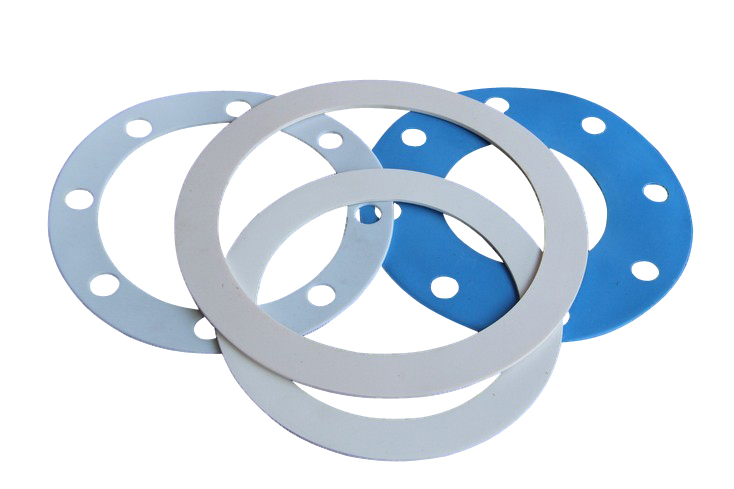
The secret to PTFE’s legendary chemical resistance is not an additive or a coating; it is the polymer chain itself. Polytetrafluoroethylene consists of a long carbon backbone, and every single hydrogen atom found in common plastics like polyethylene is replaced with a massive, highly electronegative fluorine atom. This creates a perfect, inert shield. Rubber, whether it is nitrile, EPDM, or neoprene, is built on a hydrocarbon chain with carbon-hydrogen bonds and often carbon-carbon double bonds.
This is where the fundamental difference lies. The carbon-fluorine bond is one of the strongest in organic chemistry, requiring immense energy to break. More importantly, the surrounding fluorine atoms create an electrostatic shield that repels almost all other molecules. A corrosive chemical like sulfuric acid simply cannot find a “handle” or a reaction site on the PTFE chain. In contrast, rubber’s carbon-hydrogen bonds are like open doors. Acids, bases, and solvents can easily attack these sites, leading to chain scission (breaking), cross-linking (hardening and cracking), or absorption (swelling).
Our factory relies on this principle every day. When we manufacture PTFE Gaskets, we start with virgin PTFE resin, which is inherently hydrophobic and oleophobic. Here are the specific molecular reasons for PTFE’s dominance:
From an engineering perspective, this means our PTFE Gaskets act as a truly inert barrier. You are not relying on a “resistance rating” that is valid for a limited time; you are relying on a fundamental material property that provides indefinite protection. This is why in our factory, we confidently specify PTFE Gaskets for services like 98% sulfuric acid, chlorine gas, and aniline, all of which are rubber gasket destroyers.
Speculation is worthless in sealing. Engineers need data. At Ningbo Kaxite Sealing Materials Co., Ltd., our factory runs continuous immersion tests following ASTM D543 standards to validate our PTFE Gaskets. The results consistently show a binary outcome: our PTFE Gaskets show zero or negligible change, while rubber gaskets degrade physically and chemically. Below is a comparative table showing performance after 7 days of immersion at 23°C.
| Test Chemical (Concentration) | Property Measured | Nitrile Rubber (NBR) | EPDM Rubber | PTFE Gaskets (Ningbo Kaxite) |
| 30% Hydrochloric Acid | Volume Swell / Hardness Change | Swelling +35%, Extreme Hardening | Swelling +22%, Softening | 0% Swell, No Change (Excellent) |
| 50% Sodium Hydroxide | Tensile Strength Retention | Loss of 60%, Surface Cracking | Loss of 15%, Acceptable | 100% Retention (Excellent) |
| Toluene (100%) | Weight Change / Dissolution | Dissolves into a gel | Dissolves completely | <0.1% Weight Gain (Excellent) |
| 98% Sulfuric Acid | Visual Degradation | Carbonized and cracked within 48 hrs | Not recommended, severe degradation | No visual change, perfect (Excellent) |
These results are not unique to our factory; they are a function of polymer chemistry. However, the way we process PTFE makes a difference. Our factory uses a proprietary compression molding and skiving process to create PTFE Gaskets with near-zero porosity. Any micro-void in a gasket can become a wicking path for a chemical. Our process ensures that the chemical resistance we claim is effective across the entire cross-section of the gasket. For rubber, the swelling you see in the table is often the first stage of failure. As the rubber swells, it loses its sealing stress. Then, the chemical begins to leach out curatives and plasticizers, causing the gasket to shrink and leak. This cycle of swell and shrink is not seen with our PTFE Gaskets.
Every gasket has a limit. Knowing where that limit is prevents catastrophic failure. For conventional rubber, the usable pH range is roughly 4 to 12. At high temperatures, this range narrows significantly. For PTFE Gaskets, the usable range is pH 0 to 14 across the entire temperature range of the material, from -200°C to +260°C. This is a quantifiable, massive performance advantage. The reason is thermal stability. The carbon-fluorine bond strength means that high temperatures do not activate PTFE for chemical attack the way they do for rubber.
Consider a common chemical plant scenario: a process that uses steam for cleaning (150°C) and then a strong caustic solution (pH 14). Rubber gaskets face a dual threat. The heat accelerates the hydrolysis of the rubber polymer, and the caustic attacks the crosslinks. The result is a gasket that loses all its elastic memory and becomes a hard, brittle, leaking mess. Our PTFE Gaskets, however, are immune to this. The material does not undergo a chemical change. It will creep slightly (a known property we manage with design), but it will not chemically degrade. Our factory provides specific data for every batch:
This quantifiable data leads to a simple engineering conclusion. For any application involving a pH less than 4 or greater than 12, a temperature over 120°C, or any aromatic or chlorinated solvent, a rubber gasket is a temporary solution. A PTFE Gasket from Ningbo Kaxite Sealing Materials Co., Ltd. is the permanent, reliable answer. Our factory does not just sell PTFE Gaskets; we provide a documented performance guarantee based on these fundamental chemical and thermal limits.
To conclude, PTFE Gaskets provide superior chemical resistance compared to rubber gaskets because they are chemically inert, whereas rubber is chemically reactive. The unique carbon-fluorine bond in PTFE repels attack from acids, bases, and solvents, a fact proven by immersion tests and field performance. Rubber’s carbon-hydrogen backbone is susceptible to swelling, dissolving, and embrittlement, especially at temperature extremes or in hostile pH environments. For critical sealing applications, the logical, safe, and cost-effective choice is clear.
Ready to eliminate chemical leaks and reduce downtime? Contact Ningbo Kaxite Sealing Materials Co., Ltd. today. Our engineers will help you select the exact PTFE Gaskets for your application. Request a quote or a sample kit to see the quality difference from our factory. Secure your process with the best in chemical resistance.
Q1: Can PTFE Gaskets be used in all the same applications as rubber gaskets?
A1: While PTFE Gaskets offer superior chemical resistance, they are not a universal drop-in replacement in every mechanical sense. PTFE has a property called creep or cold flow, meaning it will deform under sustained bolt load more than rubber. Our factory at Ningbo Kaxite Sealing Materials Co., Ltd. solves this by offering filled PTFE Gaskets (e.g., with glass or carbon fiber) that significantly reduce creep. Also, PTFE requires a higher initial bolt torque to achieve a proper seal due to its hardness. However, for chemical resistance, PTFE is vastly superior. The only common industrial chemicals that attack PTFE are molten alkali metals and elemental fluorine gas at high temperatures and pressures.
Q2: How does the cost of PTFE Gaskets compare to high-end fluoroelastomer (FKM/FPM) rubber gaskets?
A2: This is a common point of confusion. High-end FKM rubbers can be extremely expensive, often costing more than a standard PTFE gasket. However, our PTFE Gaskets are typically priced very competitively with standard rubbers, and are almost always cheaper than FKM. More importantly, FKM rubber still swells in many chemicals like low molecular weight esters and ethers, and it cannot handle hot caustic service. PTFE handles all of these. From a lifecycle cost perspective, a single PTFE Gasket that lasts for years is far cheaper than replacing an FKM rubber gasket every few months. Our factory provides both, and for chemical resistance, we recommend PTFE every time.
Q3: What specific tests should I request from a manufacturer to prove chemical resistance?
A3: Do not accept generic statements. Ask for ASTM D543 immersion test reports for your specific chemicals and temperatures. The report should include data on weight change, thickness swell, hardness change, and tensile strength retention. For our PTFE Gaskets, Ningbo Kaxite Sealing Materials Co., Ltd. can provide these reports, which will show essentially zero change across the board for nearly all aggressive chemicals. For rubber, the same report will show significant degradation. Additionally, ask for a permeation test using ASTM F739 for volatile organic compounds. You will find that our PTFE Gaskets have permeation rates that are orders of magnitude lower than rubber.
Q4: Why do some rubber gasket datasheets claim 'excellent' resistance to the same chemicals as PTFE?
A4: This is a critical nuance. The rubber industry often defines “excellent” as “survives for 24-72 hours without dissolving.” This is a standard for intermittent contact, not continuous sealing. A rubber gasket in a flange is under constant, continuous mechanical stress and chemical exposure. A rating of “excellent” on a chemical compatibility chart might mean the rubber will swell 30% but not disintegrate. In a real flange, that 30% swell will break the seal. For PTFE Gaskets, “excellent” means zero change in properties for years. Our factory always advises customers to look at the actual data, not the qualitative rating.
Q5: How do I install PTFE Gaskets correctly to ensure their chemical resistance is not compromised?
A5: Installation is key. First, ensure the flange surfaces are smooth and clean. Our PTFE Gaskets cannot “fill” deep scratches the way a soft rubber gasket can; they need a good surface finish. Second, follow a calibrated torque procedure. Under-torquing will cause a leak, and over-torquing can cause excessive creep. Our factory provides detailed installation guides with every order of PTFE Gaskets. Finally, never use PTFE tape as a gasket in a flange; use a full-face or ring-type PTFE Gasket from a reputable manufacturer like Ningbo Kaxite Sealing Materials Co., Ltd. to ensure a consistent, reliable seal across the entire flange face.