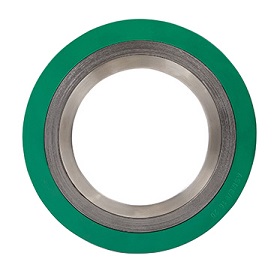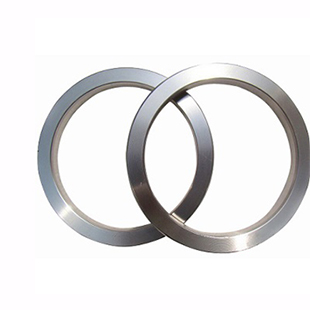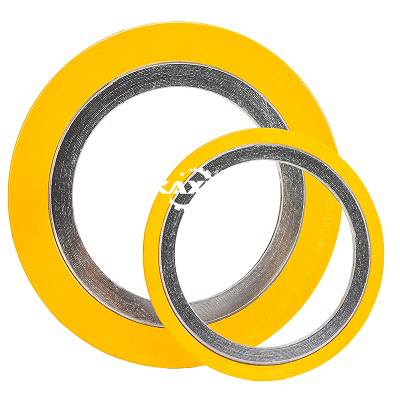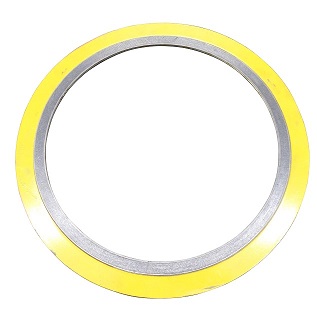

In high-temperature industrial applications—such as petrochemical refineries, power generation plants, and heat exchangers—standard gaskets often fail due to thermal degradation, creep relaxation, or loss of resilience. Metal serrated gaskets, however, are specifically engineered to excel in these demanding environments. But what makes them so suitable for high temperatures? The answer lies in their unique design and material selection. A metal serrated gasket consists of a metal core (typically stainless steel or a high-nickel alloy) with concentric serrations (grooves) on both faces, and often a soft facing material such as graphite or PTFE applied over the serrations. The metal core provides mechanical strength and thermal stability, while the serrations concentrate the sealing force into a narrow band, creating high unit loads that accommodate flange movement and thermal cycling. At Ningbo Kaxite Sealing Materials Co., Ltd., our factory has been manufacturing Serrated Gaskets for over 20 years, and we have validated their performance in temperatures ranging from -200°C to 850°C, depending on the materials used.
The suitability of metal serrated gaskets for high temperatures is driven by four key factors: the use of high-temperature-resistant metal alloys (such as 316L stainless steel, Inconel 625, or Hastelloy C276), the application of a thermally stable facing material (expanded graphite or mica), the controlled compression and recovery of the serrated design, and the minimal thermal expansion mismatch between the gasket and flange materials. Unlike soft gaskets (e.g., rubber or PTFE) which soften, creep, or oxidize at elevated temperatures, the metal core of a Serrated Gasket maintains its shape and sealing force. The serrations, when compressed, form a series of tight sealing lines that effectively block leakage paths, even under severe thermal cycling. In this comprehensive article, we will dissect the material science, design geometry, and performance characteristics that make metal serrated gaskets the preferred choice for high-temperature sealing. We will also provide detailed technical specifications, application guidelines, and real-world performance data from our factory's extensive experience.
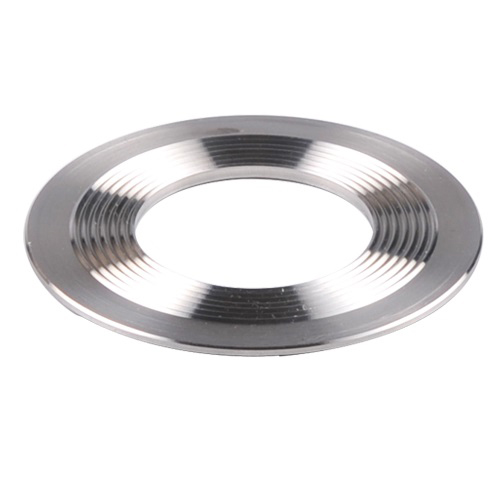
The foundation of any high-temperature Serrated Gasket is its metal core. Unlike organic or elastomeric materials, which decompose or oxidize at relatively low temperatures (typically below 200-250°C), high-performance metal alloys retain their mechanical properties and corrosion resistance at temperatures up to 850°C or even higher. At Ningbo Kaxite Sealing Materials Co., Ltd., we offer a range of metal core materials, each selected for its specific temperature and corrosion resistance characteristics. For most high-temperature applications, we recommend austenitic stainless steels (e.g., 304, 316L) for temperatures up to 600°C, and nickel-based alloys (Inconel 625, Incoloy 825) for temperatures up to 850°C or in highly corrosive environments. The metal core provides the structural integrity needed to maintain gasket stress under flange bolt loading, even as the flange and gasket undergo thermal expansion.
Key properties of metal core materials used in our Serrated Gaskets:
The choice of metal core material is crucial for achieving the desired service life. For example, in a refinery application with operating temperatures of 500°C and a corrosive process medium containing sulfur compounds, we would specify Inconel 625 core, which offers exceptional resistance to both oxidation and sulfidation. In a power plant steam line operating at 540°C, a 316L stainless steel core with a graphite facing is often sufficient. Our factory performs a rigorous material analysis for each application, considering the operating temperature, pressure, and medium corrosivity, to recommend the optimal metal core. We also conduct metallurgical tests, including hardness, tensile, and grain size analysis, on every batch of metal core material to ensure compliance with ASTM specifications.
To illustrate the practical difference, consider a case study from a petrochemical plant that used a carbon steel core gasket in a 550°C service. The gasket failed after 6 months due to oxidation and loss of thickness. After switching to our 316L stainless steel Serrated Gasket with a graphite facing, the gasket service life extended to over 4 years, with no measurable loss of sealability. This durability translates directly into reduced maintenance shutdowns, improved plant safety, and lower total operating costs. Our factory at Kaxite maintains a comprehensive database of material performance data, allowing us to select the optimal metal core for each high-temperature application.
The serrated (or grooved) design of metal serrated gaskets is not merely a structural feature—it is a key enabler of high-temperature sealing performance. The concentric serrations on the gasket faces serve multiple functions: they concentrate the bolt load into narrow circumferential bands, creating high unit sealing stresses (up to 500-700 MPa) that embed into the flange surface and provide an effective seal. They also allow for radial expansion and contraction of the gasket during thermal cycling without causing excessive stress relaxation. Furthermore, the serrations act as multiple independent sealing barriers, so that if one serration is compromised, the adjacent serrations still maintain the seal. This redundancy is particularly valuable in high-temperature applications where thermal cycling can cause flange movement and gasket movement.
Key performance-enhancing features of the serrated design in our Serrated Gaskets:
Our factory conducts extensive testing to optimize the serration geometry for different applications. We have tested serration depths from 0.15mm to 0.3mm, and pitches (distance between serrations) from 1.0mm to 2.0mm, to determine the optimal combination for specific temperature and pressure ranges. Our standard Serrated Gasket features a serration depth of 0.25mm and a pitch of 1.5mm, which we have found to offer the best balance of sealing performance and resistance to crush damage. We also offer a "fine serration" option with a pitch of 1.0mm for applications requiring extremely low leakage rates, such as vacuum service or toxic gas handling.
A real-world example from a refinery crude unit heater, operating at 480°C and with daily thermal cycles, demonstrates the value of the serrated design. The original flat graphite gaskets failed within 3 months, due to severe relaxation and blowout. After installing our Serrated Gaskets with 316L core and graphite facing, the service life extended to 3 years. The plant engineer noted that the serrated gaskets maintained their seal even after the flanges had been cycled from ambient to 480°C over 100 times, confirming the design's ability to accommodate thermal movement. At Ningbo Kaxite Sealing Materials Co., Ltd., we continue to refine our serration geometry and facing materials to meet the evolving demands of high-temperature sealing applications.
Ningbo Kaxite Sealing Materials Co., Ltd. manufactures a comprehensive range of Serrated Gaskets for high-temperature, high-pressure, and corrosive applications. Our product line includes standard and custom sizes, with various metal core materials and facing materials. The table below summarizes the key technical specifications for our most popular Serrated Gasket models, which are used extensively in petrochemical, power, and refining industries worldwide. Our factory can produce gaskets with diameters from 10mm to 5000mm, and thicknesses from 2mm to 6mm, to meet specific project requirements.
| Model | Core Material | Facing Material | Temperature Range (°C) | Max Pressure (bar) | Serration Depth (mm) | Thickness (mm) | Leakage Rate (ml/min) |
| KS-304-G | 304 Stainless Steel | Expanded Graphite | -200 to 550 | 350 | 0.25 | 2.0, 3.0 | < 0.05 |
| KS-316L-G | 316L Stainless Steel | Expanded Graphite | -200 to 600 | 400 | 0.25 | 2.0, 3.0 | < 0.03 |
| KS-316L-PTFE | 316L Stainless Steel | PTFE (for corrosive media) | -200 to 260 | 300 | 0.20 | 2.0, 3.0 | < 0.02 |
| KS-IN625-G | Inconel 625 | Expanded Graphite | -200 to 850 | 500 | 0.25 | 2.5, 3.5 | < 0.02 |
| KS-HC276-G | Hastelloy C276 | Expanded Graphite | -200 to 850 | 500 | 0.25 | 2.5, 3.5 | < 0.02 |
| KS-316L-M | 316L Stainless Steel | Mica (high-temp insulation) | -200 to 650 | 400 | 0.20 | 2.5, 3.5 | < 0.04 |
In addition to the standard offerings, our factory provides a range of custom options to address specific high-temperature challenges. We offer serrated gaskets with a "flexible" core (e.g., a corrugated metal core) for applications requiring higher compressibility, or with a "cam profile" serration for uneven flange surfaces. We can also apply a anti-stick coating (such as PTFE or nickel) on the facing to prevent gasket adhesion to the flanges, which is particularly valuable for bolted connections that need periodic disassembly.
Quality control is paramount in our manufacturing process. Each Serrated Gasket is inspected for serration depth consistency using optical measurement, for flatness using a granite surface plate, and for visual defects under high-intensity lighting. We also perform a helium leak test on random samples from each batch, achieving leakage rates below 10^-6 mbar·l/s for critical applications. Our factory at Ningbo Kaxite Sealing Materials Co., Ltd. provides a comprehensive test report with every order, including material certifications, dimensional inspection results, and leak rate data. This transparency and commitment to quality ensure that our Serrated Gaskets deliver the performance and reliability required in high-temperature environments.
Even the best-designed Serrated Gasket can fail prematurely if not installed and maintained correctly. High-temperature applications impose unique challenges on gasket installation: thermal expansion must be accounted for, bolt torque must be precisely controlled to avoid over-compression or under-compression, and the gasket and flanges must be free of contaminants that could cause oxidation or chemical attack at elevated temperatures. At Ningbo Kaxite Sealing Materials Co., Ltd., we have developed a comprehensive installation and maintenance guide based on decades of field experience. Following these guidelines can extend the service life of Serrated Gaskets by 50-100 percent, significantly reducing plant maintenance costs and unplanned shutdowns.
Key installation and maintenance practices for Serrated Gaskets in high-temperature services:
A case study from a power plant in Europe illustrates the impact of proper installation. The plant had experienced frequent failures of Serrated Gaskets on a superheated steam line (550°C, 120 bar). An analysis showed that the failures were due to non-uniform bolt torque and improper flange surface preparation. After implementing our installation guidelines—including surface cleaning, calibrated torque tools, and a post-heating re-torque procedure—the gasket life increased from an average of 8 months to over 4 years. The plant manager reported that the cost of the installation program was less than the cost of one unplanned shutdown, highlighting the return on investment in proper installation practices.
Our factory offers on-site training and installation supervision for critical projects. We also provide a re-torque calculator that factors in the specific thermal expansion coefficients of the flange and gasket materials, to determine the optimal re-torque interval. Additionally, we recommend storing Serrated Gaskets in a clean, dry environment, away from corrosive atmospheres, and using them within their shelf life (typically 2 years for graphite-faced gaskets). By following these best practices, plant operators can maximize the performance and lifespan of their Serrated Gaskets in high-temperature services.
Question 1: Can metal serrated gaskets be reused after being exposed to high temperatures?
Answer: In general, we do not recommend reusing Serrated Gaskets after they have been in service, especially at high temperatures. The facing material (graphite or mica) undergoes plastic deformation during initial compression, which cannot be fully recovered. Reusing the gasket may lead to insufficient sealing stress and increased leakage risk. However, in some low-pressure, low-temperature applications, a visual inspection may allow reuse if the facing material shows no damage. For high-temperature services, we always recommend using a new Serrated Gasket to ensure reliable sealing. Our factory provides reconditioning services for metal core gaskets where the facing material can be replaced, but the core must be inspected for warping or corrosion.
Question 2: What is the maximum operating temperature for a metal serrated gasket with graphite facing?
Answer: The maximum continuous operating temperature for a Serrated Gasket with expanded graphite facing depends on the environment. In an oxidizing atmosphere (air), the maximum temperature is typically 550°C, as graphite will begin to oxidize at higher temperatures. In an inert or reducing atmosphere, graphite can be used up to 850°C. For temperatures above 550°C in oxidizing conditions, we recommend using a mica facing or a metal-to-metal seal (without facing) for our Serrated Gaskets. Our factory provides detailed temperature charts for each facing material to help you select the appropriate option for your specific environment.
Question 3: How do metal serrated gaskets compare to spiral wound gaskets for high-temperature applications?
Answer: Both Serrated Gaskets and spiral wound gaskets are excellent for high-temperature applications, but they have different characteristics. Serrated Gaskets offer a tighter seal at higher temperatures and are less prone to winding loosening under thermal cycling. They also have a higher resistance to blowout and are more easily installed on uneven flanges. Spiral wound gaskets, on the other hand, are more flexible and can accommodate larger flange misalignment. Our factory at Ningbo Kaxite Sealing Materials Co., Ltd. recommends Serrated Gaskets for critical, high-temperature, high-pressure services where reliability is paramount, and spiral wound gaskets for less demanding applications where flange damage is a concern.
Question 4: Can metal serrated gaskets be used in vacuum services at high temperatures?
Answer: Yes, Serrated Gaskets are suitable for vacuum services at high temperatures, provided that the facing material is stable under vacuum conditions (e.g., graphite or mica). The metal core provides the necessary structural integrity to withstand the external atmospheric pressure, while the serrations ensure a leak-tight seal even at low internal pressures. For vacuum applications, we recommend a fine serration pitch (1.0mm) and a high-quality graphite facing with low outgassing characteristics. Our factory has supplied Serrated Gaskets for high-temperature vacuum furnaces operating at 800°C and 10^-5 mbar, with excellent results.
Question 5: What certifications does Ningbo Kaxite Sealing Materials Co., Ltd. hold for its metal serrated gaskets?
Answer: Our Serrated Gaskets are manufactured under ISO 9001:2015 (Quality Management) and ISO 14001:2015 (Environmental Management). We also hold the TA-Luft (VDI 2440) certification for low-emission gaskets, and we comply with the requirements of ASME B16.20 and API 607 for fire safety. Our gaskets are tested by independent third-party laboratories for compliance with ASTM standards, including ASTM F112 for leakage and ASTM F36 for compressibility. We provide a complete set of test certificates and material traceability with every shipment, ensuring full compliance with the most stringent international standards.
The suitability of metal serrated gaskets for high-temperature environments is underpinned by their robust material selection, ingenious serrated geometry, and proven performance under thermal cycling. The metal core provides the necessary strength and thermal stability, the facing materials (graphite or mica) provide conformability and chemical resistance, and the serrations create multiple, high-stress sealing lines that maintain integrity despite flange movement and bolt relaxation. At Ningbo Kaxite Sealing Materials Co., Ltd., our factory has refined the manufacturing of Serrated Gaskets over two decades, offering a wide range of materials and configurations to meet the demands of the most severe high-temperature applications. Our commitment to quality, innovation, and customer support ensures that our gaskets provide reliable, long-lasting sealing in refineries, power plants, and chemical processing facilities worldwide.
Are you facing a challenging high-temperature sealing application? Contact Ningbo Kaxite Sealing Materials Co., Ltd. today for a comprehensive gasket consultation. Provide your operating temperature, pressure, medium, and flange details, and our engineering team will recommend the optimal Serrated Gasket material and design. We offer free samples for testing, competitive pricing, and fast delivery to any location. Request your free Serrated Gasket sample and technical data pack now from Ningbo Kaxite Sealing Materials Co., Ltd. and ensure the safety and reliability of your high-temperature system.