
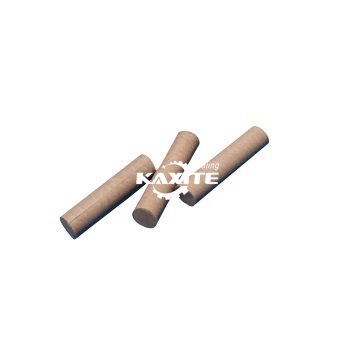
The 40% bronze-filled PTFE rod (KXT B980) is a dark brown, metal-filled PTFE stock shape for high-load, high-speed rubbing parts: bearings, piston rings, guide ways and hydraulic seal components. Bronze raises compressive strength and thermal conductivity. Not for acids or alkalis. Cut-to-size blanks and drawing-based machining available.
KXT B980 · Bronze-filled PTFE stock shape
The 40% bronze-filled PTFE rod is the workhorse grade of filled PTFE for high-load, high-speed rubbing parts: bearings, guide ways, piston rings, hydraulic seal components and wear pads that would deform or wear out too quickly in unfilled PTFE. Bronze raises compressive strength and thermal conductivity, so heat from rubbing contact is carried away instead of building up at the surface. The trade-off is chemical resistance — the material is not suitable in strong acids or alkalis — so it belongs in mechanical, not aggressive chemical, service.
Ask for a machined sample or a cut-to-size blank Bronze is the most widely specified metal filler for PTFE. At a 40% loading it sits in the middle of the usual 40–60% range, which is the band where wear resistance rises quickly without the part becoming too brittle or too hard to machine. The colour shifts to a distinctive dark brown, which makes grade mix-ups in the machine shop easy to spot. What you get in return is a rod that behaves very differently from unfilled PTFE under load.
The bronze particles transfer heat away from the rubbing surface, which keeps the PTFE from reaching the temperature where it starts to soften and deform.
Bronze carries a share of the load, so parts hold their shape under sustained pressure better than unfilled PTFE.
Heat moves through the material faster, which is why it is preferred for continuous sliding and higher-speed bearing work.
Finished parts keep their tolerance in humid or wet service, which matters for seal components and guide strips.
Rods turn, mill and drill cleanly on standard workshop equipment with carbide tooling.
This is the key limitation. Bronze-filled PTFE should not be used as a chemical seal where aggressive media are present.

If your application needs even higher wear resistance under heavy load, the 60% bronze-filled PTFE rod is the next step up in the same family.
Most enquiries about the 40% grade come down to a comparison against two alternatives. The table below shows the trade-offs that matter most on the shop floor.
| Property | Unfilled PTFE | Glass-filled PTFE | 40% Bronze-filled |
|---|---|---|---|
| Wear resistance | Moderate | Good | Excellent |
| Compressive strength | Low | Improved | High |
| Thermal conductivity | Low | Improved | Higher than glass-filled |
| Creep resistance | Low | Good | Excellent |
| Chemical resistance | Excellent | Good | Poor in acids / alkalis |
| Machinability | Easy | Moderate (abrasive to tools) | Easy |
| Typical use | Gaskets, linings, low-load seals | Seals, gaskets, moderate wear parts | Bearings, piston rings, guide ways, hydraulic seals |
Glass-filled PTFE is often a better choice where chemical resistance matters but wear is moderate; the glass-filled PTFE rod range covers that case. For mechanical duty where the part must hold load and shed heat, the bronze grade wins.
The grade is specified in applications where a metal-backed bearing is overkill, oil lubrication is undesirable, and the part must run dry or semi-dry. It is particularly suited to higher-speed shafts that are not hardened, because the bronze provides the load-bearing surface the PTFE alone cannot supply.
Rod stock for all of these applications is available from the PTFE rods range, and finished parts can be machined to drawing on request.
Rod is supplied in standard diameters and lengths, or cut to the blank size you need for machining. Tell us the finished part drawing or the required rod diameter and length, and we will confirm availability and lead time in the quotation. If the order goes to a customer's tool room, we can supply matching documentation with the shipment.
We supply single rods, cut-to-size blanks and bulk quantities for distributors; OEM and drawing-based orders are quoted with MOQ and lead time stated in writing. For applications that need a different filler combination — for example a carbon / graphite grade for chemical or dry-running service — see the wider PTFE products range before finalising the grade.
Both are bronze-filled PTFE. The 60% grade has a higher metal content, which pushes wear resistance and compressive strength further but reduces the amount of PTFE available for low-friction running. The 40% grade is the more common starting point for general bearing and seal work; the 60% grade is chosen when load is the dominant requirement.
No. Bronze filler makes the material unsuitable in strong acids and alkalis. For chemical duty, specify unfilled PTFE or a glass-filled grade, and confirm compatibility with the specific medium before ordering.
Dark brown. The colour is a practical identification aid in the machine shop — if a rod is pale or white, it is not the bronze-filled grade.
Yes. We supply standard rod stock and can cut blanks to your dimensions. For finished machined parts, provide a drawing and we will quote against it.
Send the rod diameter and length, or the finished part drawing, together with the application and quantity through the inquiry form. We will reply with availability, lead time and price within one working day.
Send the rod diameter and length, or the finished part drawing, plus quantity and application. We will reply within one working day.